Space Video of the Day Archive
Showing posts with label robotics. Show all posts
Showing posts with label robotics. Show all posts
Saturday, November 10, 2007
Space Video of the Day - 071110
Sometimes I think that the only part of NASA that is worth anything is the Jet Propulsion Lab. If you look at the last several years, the majorly cool missions - the ones where the edge of the envelope of science are being pushed - are all being done by JPL. Today's space video of the day shows JPL's latest innovation, a robot platform called ATHELETE. There are several things I like about this ATHELETE robot. First of all, it can easily be envisioned as a common platform for plenty of future robotics missions. The design is so versatile - with the legs useable as wheels or legs or tool actuators - that dozens of future missions could all be accomplished with this same platform as a basis. Secondly, I can see how this design could be packed into a launch vehicle; when all the legs are folded up, one ends up with a hexagonal prism less than a foot tall. Third, there are lots of cameras - at least a dozen pairs of stereo cameras available, surrounding the robot body and one pair on every wheel. This is the sort of thing that all of NASA should be doing: innovating. Why is it that only JPL seems to understand that?
Space Video of the Day Archive
Space Video of the Day Archive
Saturday, July 28, 2007
Space Video of the Day - 070728
Today's Space Video of the Day is a wonderful animation by Daniel Maas of the Mars Exploration Rover mission. The background music is Sunspots by Nine Inch Nails.
Space Video of the Day Archive
Space Video of the Day Archive
Friday, June 29, 2007
Sunday, June 03, 2007
self-reconfigurable robots
Google has an amazing series of lectures being given to their employees, which are then videotaped and uploaded to Google Video. The breadth of topics covered is astonishing, and always interesting. Today I'd like to share with you one of those lectures, on Self-Reconfigurable Robots and "Digital Hormones", given by Dr. Wei-Min Shen.
For a robotics geek like me, this stuff is just fascinating.
For a robotics geek like me, this stuff is just fascinating.
Saturday, April 28, 2007
WAY cool
As one can guess from the title of this blog, I'm kinda into robots. And, as a kid I was fascinated with dinosaurs, as I am sure is true of most kids. So, when you combine the two ideas and have giant robot dinosaurs, well then you've really got my attention.
Monday, April 16, 2007
parking on a dime

Literally. The Pico robot is possibly the smallest self-contained robot in the world. Yes, there are smaller robots, but none that are fully mobile and have all their control circuitry, power supply, and sensors on-board. The whole thing fits into a cube half an inch (12.5mm) on a side. Probably the best part about this robot (which moves at a blazing fast top speed of 15 centimeters per second - see if you can move 12 times your body length in one second) is that it wasn't built by some big government lab or by some big university. It was built by just one guy working on his own.
Okay, so it doesn't do the whole "edge of table" thing well, but still, it is controlling itself, changing its direction if it bumps into things. Pretty darn cool, if you ask me.
Wednesday, April 04, 2007
What NASA should be doing, but isn't
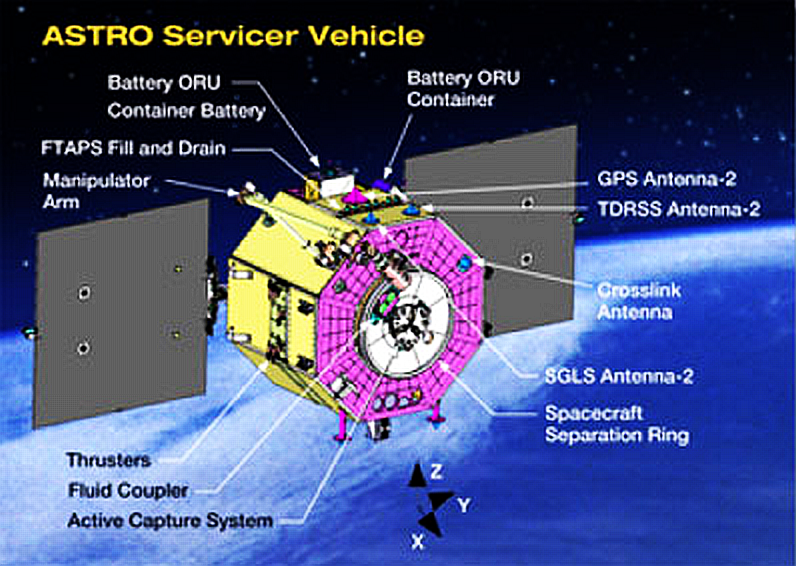
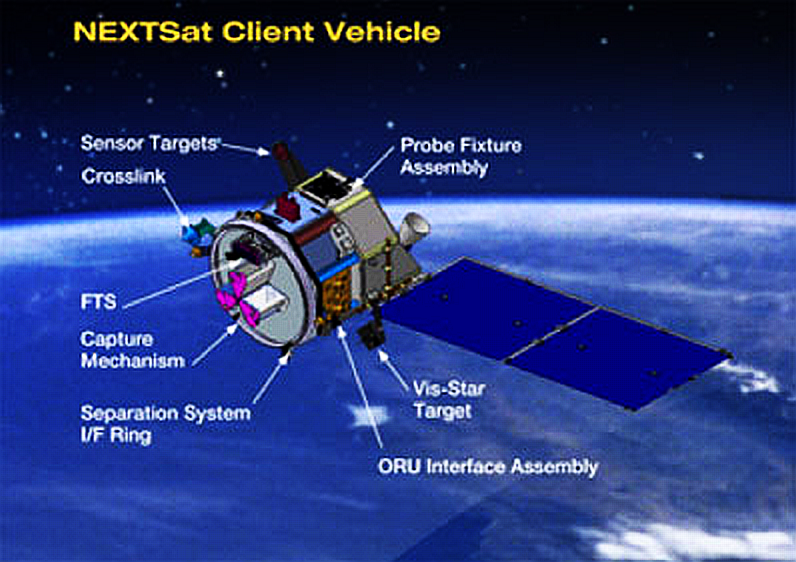
The Orbital Express program - sponsored by DARPA and launched by an Air Force Atlas V rocket a few weeks ago - is testing out several new technologies in autonomous satellite operations. The tests are being done with two satellites, called ASTRO (Autonomous Space Transfer and Robotic Orbiter) and NextSat, which are currently docked. Among technologies to be tested are multiple dockings and undockings, several propellant transfer tests, and multiple transfers of batteries and computers from one satellite to the other using a robotic arm mounted on ASTRO. This is exactly the sort of thing that NASA should be doing - testing out new technologies that expand opportunities in space - but aren't doing due to budgetary constraints (such as having to maintain a huge workforce to service the Shuttles, and keeping that same workforce employed while the Ares series of vehicles is developed).
On-orbit inspection via robotic arm mounted on ASTRO
(click on images for larger versions)
ASTRO
NextSat
Mission Timeline

launch video
(click on images for larger versions)
launch video
Subscribe to:
Posts (Atom)